




Why the Contingency Fee vs Retainer Debate Matters for Injured Texans
Contingency fee vs retainer is one of the most important decisions you’ll face when hiring a lawyer — and the difference can mean thousands of dollars in your pocket or out of it.
Here’s the short answer:
| Factor | What to Look For |
|---|---|
| Upfront Cost | $0 for contingency; hundreds to thousands for retainers. |
| When You Pay | Only if you win (contingency) vs. before work begins (retainer). |
| Who Bears the Risk | Attorney bears the risk in contingency; client bears it in retainers. |
| How Much | Percentage of recovery (contingency) vs. hourly billing (retainer). |
| Best For | Personal injury/car accidents (contingency) vs. divorce/criminal (retainer). |
| If You Lose | No attorney fees owed (contingency) vs. fees already paid (retainer). |
If you were hurt in a car accident in Austin and you’re staring down medical bills with no income coming in, the last thing you need is to hand over thousands of dollars just to get a lawyer in your corner. That’s exactly why the fee structure your attorney uses matters — it shapes not just how much you pay, but when you pay and whether you pay at all if things don’t go your way.
I’m Joe Lopez, founder and lead trial attorney at Joe Lopez Law. Over my 20-plus years handling personal injury and catastrophic litigation in Austin, I’ve seen how the contingency fee vs retainer structure shapes whether injured Texans can even afford to fight back — and I’ve used the contingency model to recover millions for clients who had nowhere else to turn.
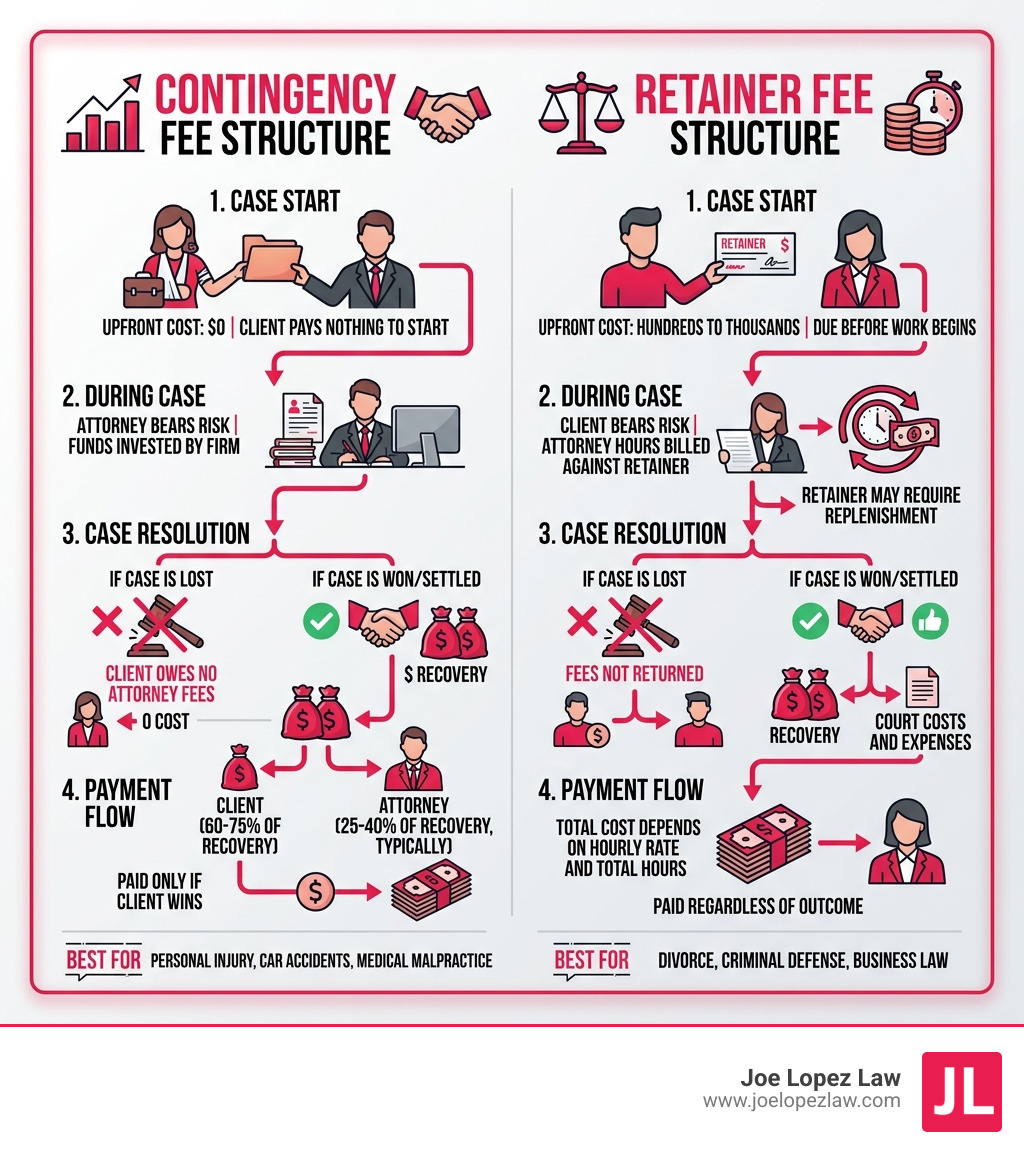
Understanding the Contingency Fee vs Retainer Structure

When we talk about the contingency fee vs retainer debate, we are really talking about how risk is distributed. In the legal world, time is the primary currency. A lawyer’s expertise and the hours they spend researching, filing motions, and arguing in court are what you are paying for. However, how those hours are billed depends entirely on the agreement you sign.
In a retainer-based system, you are essentially “pre-purchasing” the lawyer’s time. You provide an upfront payment, and the lawyer bills their hourly rate against that amount. Once the money in that account runs low, you must “replenish” it. This provides the lawyer with guaranteed income but leaves you, the client, with the financial burden of paying for every email, phone call, and court appearance, regardless of whether you win your case.
On the flip side, a contingency fee is outcome-driven. According to What’s the Difference Between a Retainer vs. Contingency Fee?, a contingency fee means the attorney is only paid if they successfully secure a settlement or judgment for you. Instead of billing you by the hour, the lawyer takes a pre-agreed percentage of the final recovery.
| Factor | What to Look For |
|---|---|
| Upfront Payment | Required for retainers; $0 for contingency. |
| Financial Risk | Borne by client in retainers; borne by lawyer in contingency. |
| Case Types | Family/Criminal for retainers; Personal Injury for contingency. |
| Final Cost | Based on hours worked vs. percentage of recovery. |
What is a Contingency Fee Agreement?

To understand this model, it helps to look at the Merriam-Webster Contingency Definition, which describes a contingency as an event that may but is not certain to occur. In legal terms, your lawyer’s payment is “contingent” upon winning.
A Contingency Fee Agreement Texas is a written contract that outlines exactly what percentage of the recovery the lawyer will receive. This structure is often called “the key to the courthouse” because it allows people who don’t have thousands of dollars sitting in a bank account to hire the best legal talent available.
Advantages of a Contingency Fee vs Retainer for Plaintiffs
For a plaintiff—the person bringing the lawsuit—the contingency model offers a massive financial safety net. Because the lawyer is taking on the risk of working for free if the case is lost, their interests are perfectly aligned with yours. They are incentivized to get the maximum recovery possible, as their own paycheck depends on it.
Furthermore, statistics show that contingency fees commonly range from 25% to 40% of the final settlement. While this might seem like a large chunk, consider the alternative: if you were paying $300 to $500 an hour for a case that takes two years to resolve, you could easily end up owing more in legal fees than the case is worth. Under a contingency plan, you avoid debt accumulation and enjoy shared success with your counsel. As noted in What Percentage Do Lawyers Take For a Personal Injury Case, this model ensures that the lawyer only profits when you do.
Common Cases for Contingency Fees
You will most often see this fee structure in civil cases where a monetary award is the goal. This includes:
- Car Accidents: If you’ve been hit on I-35 or Mopac, a car accident lawyer Austin will typically work on contingency.
- Medical Malpractice: These cases are incredibly expensive to litigate, often requiring expert witnesses that cost thousands of dollars.
- Workplace Injuries: When an employee is hurt and out of work, they rarely have the funds for a retainer.
- Wrongful Death: Families grieving a loss shouldn’t have to worry about hourly billing.
For more details on local practices, you can see How Do Car Accident Lawyers In Austin Typically Charge Their Clients.
What is a Retainer Fee Agreement?
A retainer fee is essentially a down payment. When you hire an attorney on a retainer, you place a set amount of money—ranging from a few hundred to several thousand dollars—into a trust account. As the lawyer works on your case, they “bill against” that retainer.
According to The Difference Between a Contingency Fee and a Retainer, lawyers are ethically and legally prohibited from taking that money out of the trust account until the work has actually been performed. However, once the work is done, that money belongs to the firm. The Cambridge Dictionary Contingency Definition reminds us that this is a “provision for an unforeseen event,” but in a retainer agreement, you are paying for the lawyer’s availability and time, not necessarily a specific result.
Financial Risks of a Contingency Fee vs Retainer
The biggest risk of a retainer is budgeting uncertainty. If a divorce becomes “messy” and requires dozens of extra hours of mediation or litigation, the client must keep pouring money into the retainer account. If the money runs out and isn’t replenished, the lawyer may stop work.
Conversely, in the contingency fee vs retainer comparison, the risk in a contingency case is almost entirely on the lawyer. If we spend 500 hours on a case and lose at trial, we get paid zero. This is why personal injury firms are very selective about the cases they take—they are essentially betting their own firm’s resources on your success.
Hidden Costs and Expenses in Legal Billing
It is a common misconception that “contingency” means “completely free.” While you don’t pay attorney fees upfront, there are still costs associated with a lawsuit. These are often referred to as “disbursements” or “litigation expenses.”
Common expenses include:
- Court Filing Fees: The cost to actually start a lawsuit with the Travis County clerk.
- Medical Record Retrieval: Hospitals often charge per page to provide the evidence we need.
- Expert Witness Fees: In a medical malpractice or complex truck accident case, we may need to hire accident reconstructionists or doctors to testify. These experts can cost $500 to $1,000 per hour.
- Deposition Costs: Paying for a court reporter to transcribe testimony.
As explained in What’s the Difference Between a Retainer vs. Contingency Fee?, these costs are typically deducted from the final settlement after the attorney’s percentage is taken. It is vital to understand whether your lawyer calculates their fee based on the “Gross” settlement (the total amount) or the “Net” settlement (what’s left after expenses).
Frequently Asked Questions about Legal Fees
What happens if I lose my case on a contingency basis?
This is the “No Win, No Fee” guarantee. If your attorney does not secure a recovery, you generally do not owe them any attorney fees. This prevents you from ending up in debt or facing wage garnishment just for trying to seek justice. However, you should always check your specific contract to see if you are responsible for out-of-pocket costs (like filing fees) if the case is lost. Most reputable firms, including ours, cover these costs upfront so the client is never at risk.
How much do lawyers take from a personal injury settlement?
In Texas, the standard is usually around 33.3% (one-third) if the case settles before a lawsuit is filed. If the case requires filing a lawsuit or going to trial, the percentage often increases to 40% to account for the significantly higher workload and risk. Some states, like New Jersey, have strict sliding scales (e.g., 33% of the first $750k, 30% of the next), but Texas offers more flexibility for negotiation between the client and the attorney.
Can a lawyer charge both a retainer and a contingency fee?
Yes, these are called “hybrid” agreements. For example, a client might pay a smaller upfront retainer to cover initial investigations, with the lawyer taking a lower-than-normal percentage of the final win. This is rare in standard car accident cases but can happen in complex commercial litigation or high-stakes employment disputes.
Choosing the Right Fee Structure for Your Case
Deciding between a contingency fee vs retainer depends entirely on your goals. If you are a business owner looking for a contract review, a retainer is the standard. But if you are an individual in Austin who has been sidelined by an injury, the contingency model is almost always the superior choice. It levels the playing field against massive insurance companies that have unlimited resources to fight your claim.
At Joe Lopez Law, we believe that your ability to pay shouldn’t dictate your access to the justice system. With over 20 years of trial experience and a track record of multimillion-dollar recoveries, we handle our personal injury cases on a contingency basis. This means we are partners in your recovery. We take on the financial risk, we pay for the experts, and we do the heavy lifting in court—and we only get paid when we put money in your pocket.
If you’ve been injured and are worried about how to afford a top-tier legal team, contact us for a free consultation. We’ll review your case, explain our Contingency Fee Agreement Texas in plain English, and show you why our trial-tested advocacy is the right choice for your path to justice.