




When a Truck Hits You From Behind: What You Need to Know
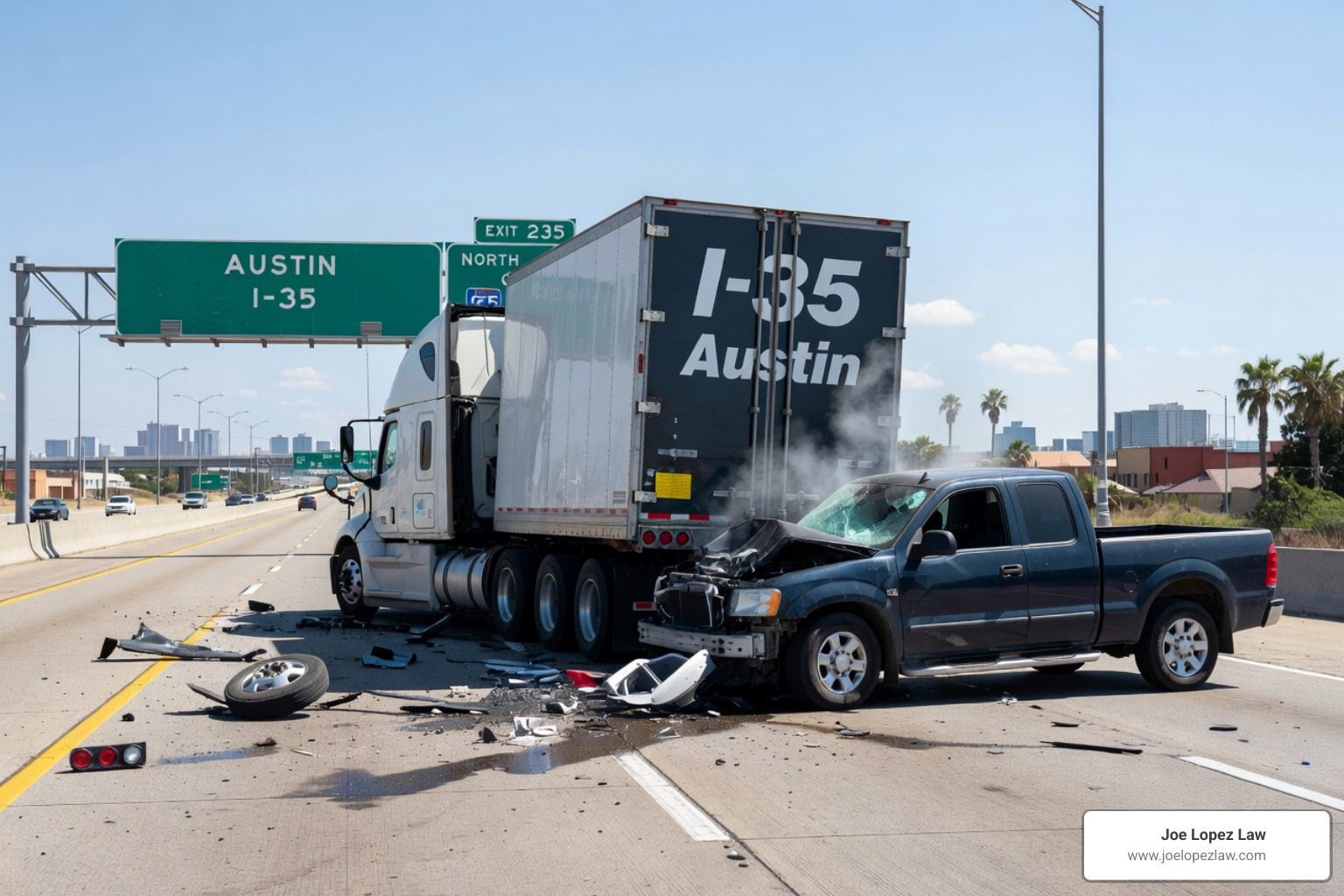
A rear end truck accident is one of the most violent collisions you can survive — and the consequences can follow you for the rest of your life.
Here’s a quick overview of what these crashes involve:
- What it is: A commercial truck strikes the back of another vehicle, usually due to driver error, mechanical failure, or dangerous road conditions
- Why it’s severe: A fully loaded semi-truck can weigh up to 80,000 lbs — 20 to 30 times more than a passenger car
- Stopping distance: At 65 mph, a loaded truck needs about 525 feet to stop. A car needs only 316 feet
- Common causes: Distracted driving, driver fatigue, speeding, tailgating, brake failure, and bad weather
- Who can be liable: The truck driver, the trucking company, a cargo loader, a maintenance provider, or a manufacturer
- What victims can recover: Medical bills, lost wages, pain and suffering, and more
- Time limit in Texas: You generally have 2 years from the date of the crash to file a claim
Rear-end collisions already account for nearly 30% of all U.S. car accidents. But when the vehicle doing the hitting is an 18-wheeler, the injuries aren’t just worse — they can be catastrophic and permanent.
In 2019 alone, rear-end truck accidents in the U.S. led to 4,689 deaths, over 78,000 injuries, and more than 150,000 property damage incidents. These aren’t fender benders. They’re life-changing events.
If you or someone you love was hit by a truck in Austin, understanding why these crashes happen — and who is responsible — is the first step toward getting the compensation you deserve.
The Physics and Dangers of a Rear End Truck Accident
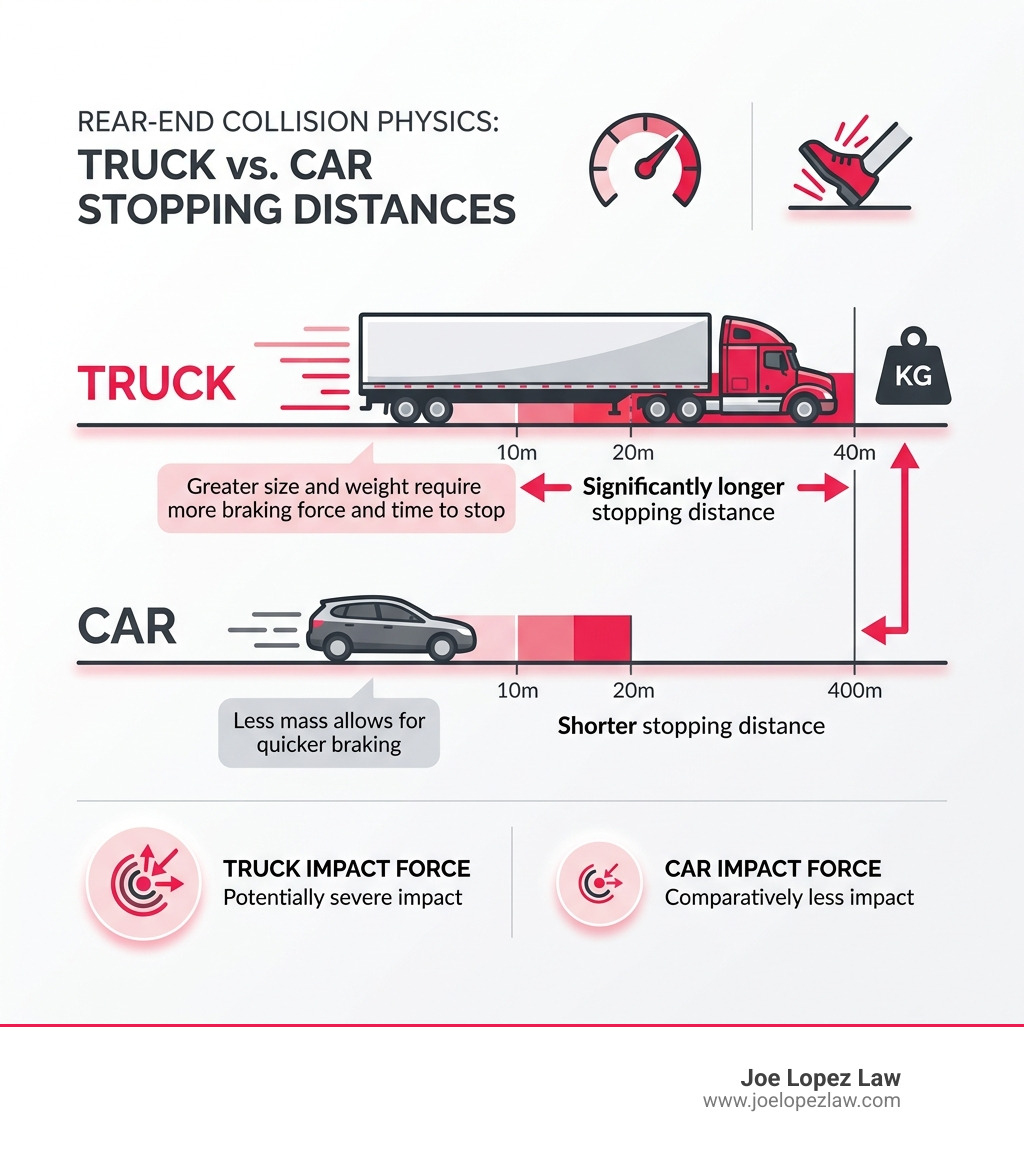
To understand why a rear end truck accident is so much more devastating than a typical fender bender, we have to look at the cold, hard laws of physics. When an 80,000-pound machine slams into a 3,000-pound sedan, the smaller vehicle absorbs almost all of the energy.
Weight and Momentum
A fully loaded tractor-trailer weighs 20 to 30 times more than a passenger car. This massive weight creates incredible momentum. Even if a truck driver manages to hit the brakes before impact, the truck is still carrying enough force to crush a car’s trunk into its backseat. This disparity is why large truck collisions are so uniquely dangerous.
Stopping Distance and Air Brakes
One of the most critical factors in these accidents is the stopping distance of a semi-truck vs a car. According to the FMCSA, a fully loaded truck traveling at 65 mph takes about 525 feet to stop — nearly the length of two football fields. In contrast, a passenger car takes about 316 feet.
| Vehicle Type | Weight (lbs) | Stopping Distance (65 mph) |
|---|---|---|
| Passenger Car | 3,000 – 4,000 | 316 feet |
| Fully Loaded Semi | Up to 80,000 | 525 feet |
Adding to this danger is the big rigs’ use of air brakes. Unlike the hydraulic brakes in your car, which engage almost instantly, air brakes have a slight delay (brake lag) as air travels through the system. Those fractions of a second can mean the difference between a close call and a fatal collision.
The Horror of Underride Collisions
Perhaps the most terrifying aspect of a rear end truck accident is the risk of an underride collision. Because truck trailers sit much higher than car hoods, a car can slide underneath the back of the trailer. This often shears off the roof of the car, leading to decapitation or severe head trauma for the occupants. While federal law requires rear under guards, these safety devices are often only required to withstand a 35 mph impact. At highway speeds common on I-35 or Loop 375, these guards frequently fail.
Common Causes of a Rear End Truck Accident
Most of these accidents are entirely preventable. When we investigate these cases in Austin and El Paso, we often find that negligence played a major role.
- Distracted Driving: Looking at a phone for just 5 seconds at 55 mph is like driving the length of a football field blindfolded. For a truck driver, that “blind” distance is even more dangerous because they cannot maneuver quickly to avoid a hazard.
- Driver Fatigue: Truckers are often under intense pressure to meet deadlines. Despite FMCSA’s limits on driving hours, many drivers push past their limits. Scientific research on truck driver sleepiness shows that fatigue can impair a driver as much as alcohol.
- Tailgating: Because trucks need so much room to stop, following too closely is a recipe for disaster. If traffic slows suddenly, the trucker has zero margin for error.
- Mechanical Failure: Worn-out brakes or tires can lead to disaster. If a trucking company skips maintenance to save a few bucks, they are putting everyone on the road at risk.
- I-35 Specific Hazards: In Austin, the constant construction and sudden traffic “bottlenecks” make I-35 a hotspot for rear-end collisions. We’ve analyzed the top causes of accidents on I-35 and found that the combination of high speed and sudden stops is a leading factor.
Catastrophic Injuries and Long-Term Consequences
The medical aftermath of being rear-ended by a semi-truck is rarely “minor.” Even if you walk away from the scene, the internal damage can be life-altering.
Traumatic Brain Injuries (TBI)
The sudden jolt of a rear-end impact can cause the brain to strike the inside of the skull. A traumatic brain injury can lead to permanent cognitive impairment, memory loss, and personality changes.
Spinal Cord Damage and Paralysis
The force of a truck crash often leads to spinal damage. This can range from herniated discs to complete paralysis. The lifetime cost of treating paralysis can exceed $3 million, making it essential to recover full compensation.
Amputations and Crush Injuries
In underride or high-speed collisions, limbs can be crushed or severed. These injuries require multiple surgeries, prosthetics, and years of physical therapy.
The Invisible Scars: PTSD and Amaxophobia
Not all injuries are physical. Many survivors suffer from post-traumatic stress disorder (PTSD), experiencing flashbacks and severe anxiety. Some develop amaxophobia, an intense fear of driving or being in a vehicle, which can make returning to a normal life nearly impossible.
Proving Liability After a Rear End Truck Accident
Proving who is at fault in a truck accident is significantly more complex than a standard car crash. There are often multiple parties involved, each with their own insurance company and legal team.
Who Is Liable?
In Austin, multiple parties can be held liable:
- The Driver: For speeding, distraction, or impairment.
- The Trucking Company: Under the doctrine of “vicarious liability,” the company is responsible for the actions of its employees. They can also be sued for negligent hiring or failing to enforce driver fatigue regulations.
- Maintenance Providers: If a third party failed to repair the brakes correctly.
- Manufacturers: If a defective part, like a tire blowout or brake failure, caused the crash.
Crucial Evidence
To win a case, we must act quickly to preserve evidence before it “disappears.” This includes:
- Black Box Data: Most modern trucks have an Electronic Control Module (ECM) that records speed, braking, and engine performance at the time of the crash.
- Electronic Logging Devices (ELD): These show if the driver violated federal hours-of-service rules.
- Maintenance Logs: To see if the truck was overdue for an inspection.
- Dashcam Footage: Both from the truck itself and any nearby vehicles.
Dealing with Insurance Companies
Trucking companies carry massive insurance policies, often starting at $750,000 but frequently reaching millions. Because the stakes are so high, insurance companies handle truck claims aggressively. They may send adjusters to the scene of the crash to minimize their liability before you’ve even seen a doctor.
Texas Laws and Compensation Recovery
Texas follows a “modified comparative negligence” rule, also known as the 51% bar rule. This means you can recover damages as long as you are 50% or less at fault. However, your compensation will be reduced by your percentage of fault. For example, if you are awarded $100,000 but found 10% at fault, you would receive $90,000. If you are 51% or more at fault, you recover nothing.
Victims can seek various types of compensation after an Austin truck accident:
- Economic Damages: Medical bills, future care costs, lost wages, and property damage.
- Non-Economic Damages: Pain and suffering, emotional distress, scarring, and loss of enjoyment of life.
In Texas, the statute of limitations is generally two years from the date of the accident. While that might seem like a long time, building a case against a multi-billion dollar trucking company takes months of investigation.
Immediate Steps to Take After a Collision
What you do in the minutes and days following a rear end truck accident can determine the success of your legal claim.
- Call 911 Immediately: Ensure police and paramedics are dispatched. A police report is a vital piece of evidence.
- Seek Medical Care: Even if you feel “fine,” the adrenaline can mask serious internal injuries or TBIs. Get checked out at an ER or urgent care.
- Document the Scene: If you are physically able, take photos of the truck, your car, the skid marks, and any road signs.
- Gather Witness Info: Get names and phone numbers of anyone who saw the crash.
- Do Not Sign Anything: The trucking company’s insurance may offer you a quick settlement. This is almost always a “low-ball” offer designed to make you go away before you know the full extent of your injuries.
- Preserve Evidence: Do not repair your car until it has been inspected by an expert.
- Contact an Attorney: Consult with a firm that understands the steps to take after a truck accident.
Frequently Asked Questions
Is the truck driver always at fault in a rear-end collision?
While there is a strong presumption that the rear driver is at fault, it is not automatic. The front driver may be held liable if they had malfunctioning brake lights, made an illegal and sudden lane change, or were reversing on a roadway. In Texas, the evidence must be carefully reviewed to apportion fault correctly.
How much insurance coverage do trucking companies carry?
Federal law requires commercial trucks to carry at least $750,000 in liability insurance. However, for trucks carrying hazardous materials, that requirement jumps to $5 million. Most large fleets carry “umbrella” policies that provide much higher coverage limits to protect against catastrophic injury claims.
How long do I have to file a lawsuit in Texas?
The statute of limitations in Texas is typically two years from the date of the crash. If you miss this deadline, you lose your right to sue. It is best to start the process as soon as possible while evidence is still fresh.
How long does a truck accident settlement take?
There is no set timeline. Simple cases might settle in a few months, but complex cases involving catastrophic injuries can take a year or longer. We provide detailed insights on settlement timelines in Austin to help our clients manage expectations.
Conclusion
A rear end truck accident is a traumatic event that can leave you with mounting medical bills, physical pain, and an uncertain future. You shouldn’t have to face the trucking companies and their insurance giants alone.
At Joe Lopez Law, we bring over 20 years of trial experience to every case. We understand the specific dangers of Texas highways and have a proven track record of securing multimillion-dollar recoveries for our clients. Whether we are investigating a crash on I-35 in Austin or a collision in El Paso, our goal is to ensure you receive the full compensation you need to rebuild your life.
If you or a loved one has been injured, don’t wait for the insurance company to do the right thing — they rarely do. Contact an Austin truck accident lawyer today for a free consultation. We are here to fight for you.