



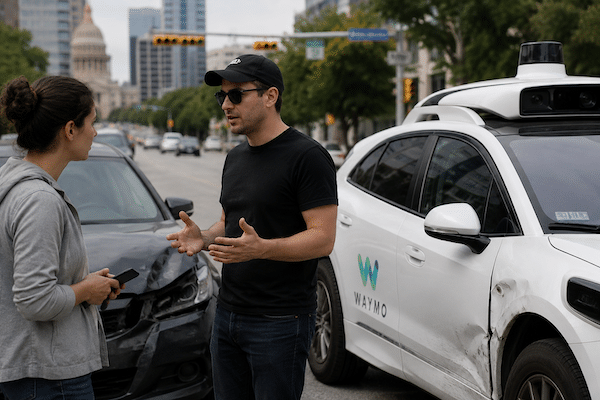
If you have been injured in an accident involving a Waymo autonomous vehicle on the streets of Austin, you are likely facing a mountain of questions, stress, and physical pain. Dealing with the aftermath of a car crash is hard enough when it involves two human drivers. When the vehicle that struck you was operating entirely on software, sensors, and cameras without a human behind the wheel, the situation becomes vastly more complicated.
Medical bills can pile up quickly, time missed from work can strain your family’s finances, and corporate insurance adjusters may already be trying to minimize your injuries. You need clear answers about who is responsible for your losses and how Texas law protects your rights.
Shifting from Driver Negligence to Product Liability
In a traditional Texas car accident, determining fault centers on human negligence. Did the other driver run a red light on Lamar Boulevard? Were they texting while driving down Interstate 35? Texas operates under a modified comparative negligence system, meaning the person or entity responsible for causing the crash is financially liable for the resulting damages.
With driverless vehicles, the legal framework changes dramatically. Because there is no human driver to blame for a sudden lane change or a failure to yield, liability typically shifts away from driver negligence and into the realm of product liability and corporate negligence.
When a driverless car causes a wreck, the primary target for liability is the company that designed, manufactured, and operated the automated driving system. In Austin, that entity may be Waymo LLC, which operates Waymo rides in Austin through Uber.
Potential Liable Parties in an Autonomous Vehicle Crash
Determining liability requires a deep dive into the technology and the sequence of events leading up to the collision. Multiple corporate entities may share fault for your injuries, including:
- The Technology Developer (Waymo): Waymo develops the proprietary software, artificial intelligence algorithms, and autonomous driving systems that control the vehicle. If a software glitch, mapping error, or algorithmic failure caused the vehicle to misinterpret traffic patterns or freeze in an intersection, Waymo can be held directly liable.
- The Vehicle Manufacturer: Waymo utilizes vehicles manufactured by other companies, such as the Jaguar I-PACE, and retrofits them with autonomous technology. If a mechanical defect unrelated to the self-driving software, such as a brake failure or steering column defect, caused the crash, the vehicle manufacturer may share liability.
- Component Parts Manufacturers: A driverless car relies on an intricate network of hardware, including LiDAR (Light Detection and Ranging) sensors, radar, long-range cameras, and onboard computers. If a third-party manufacturer supplied a defective sensor that failed to detect a pedestrian or cyclist, that manufacturer could be brought into a product liability lawsuit.
- Maintenance and Fleet Operations Contractors: Waymo maintains fleets of vehicles that must be constantly calibrated, cleaned, and repaired. If a local maintenance contractor failed to properly secure a sensor or ignored a known hardware malfunction before sending the vehicle out onto Austin streets, their negligence could be a contributing factor.
How Texas Law Frameworks Driverless Car Wrecks
Texas passed legislation under Senate Bill 2205 to regulate the operation of automated motor vehicles on public highways. Under Texas Transportation Code Chapter 545, Subchapter J, an automated driving system is legally considered the “driver” of the vehicle when it is fully engaged, regardless of whether a human is sitting in the driver’s seat.
Texas Legal Requirements: State law mandates that the owner of an automated driving system must accept legal responsibility for the vehicle’s operations and must maintain a minimum of $1 million in commercial automobile liability insurance coverage to cover bodily injury, death, and property damage.
While this statutory insurance requirement ensures that financial resources exist to compensate victims, recovering those funds is rarely straightforward. Waymo and its parent company, Alphabet, possess immense legal and financial resources. They employ sophisticated defense teams whose primary goal is to protect corporate assets and limit legal precedents that could hinder the expansion of driverless fleets.
The Evidence Needed to Prove a Driverless Car Claim
Proving liability in an autonomous vehicle crash requires highly technical data that is entirely controlled by the defendant. Unlike a standard crash where you might rely on eyewitness statements and a police report from the Austin Police Department, a driverless car claim requires specialized digital evidence.
To build a strong case, an attorney must secure and analyze:
- Onboard Event Data Recorders (EDR): Similar to a commercial truck’s “black box,” these devices record vehicle speed, braking status, steering input, and system diagnostics in the seconds leading up to an impact.
- Sensor and Camera Feeds: Waymo vehicles continuously capture 360-degree video, LiDAR data, and radar imagery of their surroundings. This data can conclusively show what the vehicle “saw” and why it failed to react appropriately.
- Software Logs and Over-the-Air Update Records: Examining the code and system logs can reveal whether a software bug caused a system latency issue or if a recent software update introduced a critical flaw into the vehicle’s driving logic.
Because this data can be easily overwritten or lost during routine corporate operations, it is vital to issue a formal spoliation letter, a legal demand to preserve all evidence, immediately following an accident.
Navigating the Corporate Legal Machine
When you are hurt, trying to negotiate with a multi-billion-dollar tech conglomerate on your own puts you at a severe disadvantage. Corporate insurers often try to delay claims, point fingers at other component manufacturers, or offer quick, lowball settlements before the true extent of your medical needs or traumatic brain injuries are fully diagnosed.
You deserve a dedicated legal advocate who limits their caseload so that your story never gets lost in a high-volume personal injury mill. You need a team that is prepared to review technical data, depose corporate representatives, and stand firm against insurance companies that refuse to pay fair value.
If you or a loved one has been harmed by an autonomous vehicle, contact an experienced Austin Waymo Accident Lawyer at Joe Lopez Law to schedule a free, confidential consultation. We represent injured plaintiffs exclusively, work on a contingency-fee basis with zero upfront costs, and possess the tenacity required to hold major corporations accountable under Texas law.
This article is intended for general informational purposes only and does not constitute legal advice. No attorney-client relationship is formed by reading this content. For advice specific to your situation, please consult a licensed attorney in Texas.