



Insurance companies fight concussion claims in Texas because the records they rely on rarely show the injury. A “mild” label in the ER chart and a normal CT scan don’t rule out a brain injury, but adjusters use both to value your claim like a sprain.
What proves a mild traumatic brain injury (TBI) is the record built after the ER: follow-up care, the right testing, and the people who saw you change. Here’s how insurers attack these claims, what beats each tactic, and why the first few months decide what the case is worth.
“Mild” Describes the First Hour, Not the Rest of Your Life
A “mild” TBI label describes how you looked right after the injury, not how serious your symptoms are or how long they’ll last. It’s based on a Glasgow Coma Scale score of 13 to 15, loss of consciousness under 30 minutes (or none at all), and memory loss lasting less than a day.
Adjusters treat it like a verdict anyway. Expect to see your ER notes quoted back to you: “GCS 15,” “alert and oriented,” “no loss of consciousness.” Each line may be accurate. None of them rules out a brain injury, and many people with lasting concussion symptoms never blacked out.
The answer isn’t to argue with the ER chart. It’s to build the record that comes after it: the follow-up visits, the referrals, the testing, and the people who noticed you changed.
Why a Normal CT Scan Doesn’t Mean a Normal Brain
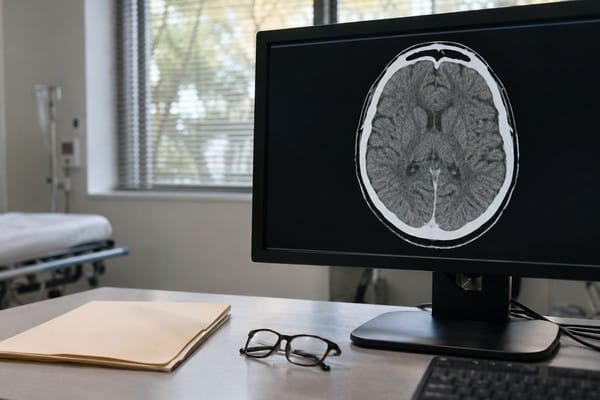
A normal CT scan doesn’t mean you don’t have a concussion. Emergency rooms order CT scans to find bleeding or swelling that might need surgery. That’s what the test is good at. It isn’t designed to show the microscopic damage common in concussions.
The research backs this up. In a UCSF-led study of 135 people with mild TBIs, 99 had normal CT scans, and more than a quarter of those 99 showed signs of injury on an MRI taken about a week later. The study’s senior author said it plainly: a normal CT scan doesn’t mean you’re normal.
Adjusters lead with the clean CT anyway, because it works on people who don’t know better. When your doctors order an MRI or send you to a neurologist, that isn’t over-treatment. It’s often the first test aimed at the injury you actually have.
The Record Gaps Insurers Look For
Insurers rarely deny a mild TBI claim over one big fact. They build the denial out of small gaps in your record:
- The scene. You told the officer or the other driver you were fine. Adrenaline does that, and concussion symptoms often show up hours or days later.
- The delay. You drove home after a rear-end crash on I-35 and didn’t see a doctor for two weeks. The insurer will argue everything after that gap is unrelated. If that’s your situation, read what to do if you didn’t see a doctor after a car accident. A gap can be explained, but someone has to explain it.
- The treatment gaps. Missed follow-ups or a month without care get framed as proof that you recovered.
- Going back to work. Returning to your job, even if you’re struggling through every shift, gets used as evidence that nothing is wrong.
- Your phone. One smiling photo at a birthday dinner becomes “full recovery.” This is one of the ways Austin insurance companies use your social media against you.
- Your history. An old concussion from high school football or a prior wreck gets blamed for everything. Texas law holds a defendant responsible for making an existing condition worse. The catch is that you have to prove what changed.
What Changes When a TBI Case Is Built for Trial
Once a Texas brain injury case is in litigation, the defense can attack the injury directly with its own neuropsych exam and challenges to your medical bills. The case has to be built from the start to survive both, and one built only for a quick settlement isn’t.
The defense neuropsych exam. Under Texas Rule of Civil Procedure 204, the defense can ask a court to order a mental examination by its own expert. The court can order it only for good cause, and only when your mental condition is in controversy or you’ve designated a psychologist as a testifying expert. That exam will likely include “effort” or symptom-validity testing, and a low score there is how a defense expert labels someone as exaggerating. Your own testing has to be done carefully by a qualified neuropsychologist so it holds up next to theirs. Before a lawsuit is filed, you have no obligation to see the other driver’s insurance doctor, because you have no contract with that company. Your own policy may have different rules, especially for uninsured motorist claims, so talk to a lawyer before agreeing to any exam or recorded statement.
The fight over your medical bills. Texas lets injured people prove medical bills through sworn affidavits under Civil Practice and Remedies Code §18.001. The defense can file counteraffidavits challenging whether the treatment was reasonable and necessary. Brain injury treatment, including neurology visits, cognitive and vestibular therapy, and neuropsych testing, is a common target. When that happens, those bills have to be proven with expert testimony instead of paperwork.
The before-and-after witnesses. The strongest proof in a concussion case often isn’t medical. It’s your spouse describing arguments that never used to happen, the supervisor who noticed new mistakes, or the friend who says you stopped driving at night. Joe Lopez Law identifies and prepares those witnesses early, while their memories are specific.
Future losses. If the injury affects how you think, it can affect what you earn for decades. Proving that can take a vocational expert, an economist, and in more serious cases a life care plan. That’s the difference between a settlement that covers your medical bills and one that accounts for your lost earning capacity.
A Problem Few Firms Talk About: Testing Spanish Speakers
If you speak Spanish, how your brain injury gets tested can matter as much as the injury itself. Neuropsychological tests are scored against “norms,” meaning results from the groups of people a test was standardized on. For years, many of those norms came from English-speaking populations. Researchers have found that using English-speaker norms can make healthy Spanish speakers in the U.S. look impaired on memory tests.
In a lawsuit, that cuts in strange directions. A defense expert can say low scores reflect language or education instead of the injury. A test given in English, or through an untrained interpreter, can be attacked or turned against you. For Spanish-speaking clients, testing should be done in Spanish by an examiner using appropriate norms, from the start.
Joe Lopez grew up in El Paso and is fluent in Spanish. He can explain what the testing means, why the defense exam matters, and what to expect, directly and without a translator in the room. Se habla Español.
Where the Money Comes From in a Serious Brain Injury Case
In a serious brain injury case, the money usually has to come from more than one source. Texas requires drivers to carry only $30,000 in bodily injury coverage per person, and a brain injury with lasting symptoms can blow through that fast. Other sources include:
- Commercial defendants. Trucking companies, contractors, and delivery companies carry far larger policies than individual drivers.
- Property owners and businesses. They can be responsible for falls that cause head injuries.
- Your own coverage. Your uninsured/underinsured motorist coverage can step in when the at-fault driver doesn’t have enough.
Joe Lopez Law has handled both kinds of brain injury cases. The firm secured a $3.85 million settlement in a slip-and-fall case involving a traumatic brain injury, with a net recovery to the client of $2,393,074.55. It also secured a $1.25 million settlement in a cement truck crash involving a traumatic brain injury. Past results do not guarantee a similar outcome in your case.
Talk to Joe Lopez Law Before You Accept a “Mild” Valuation
Don’t wait to feel better before you get answers. Most Texas personal injury lawsuits must be filed within two years of the injury, and claims against government entities can require written notice much sooner. Concussion symptoms can take weeks to fully show up, and the deadline keeps running while they do.
If the insurance company is calling your concussion minor, pointing to a clean CT scan, or pushing a quick offer, get your case reviewed before you sign anything. Call Joe Lopez Law at (512) 580-9962 for a free case review. You pay no attorney fees unless the firm recovers compensation for you, and the firm pays upfront case expenses. Se habla Español.
This article is for informational purposes only and does not constitute legal advice. Reading it does not create an attorney-client relationship. For advice about your situation, consult a licensed Texas attorney.