



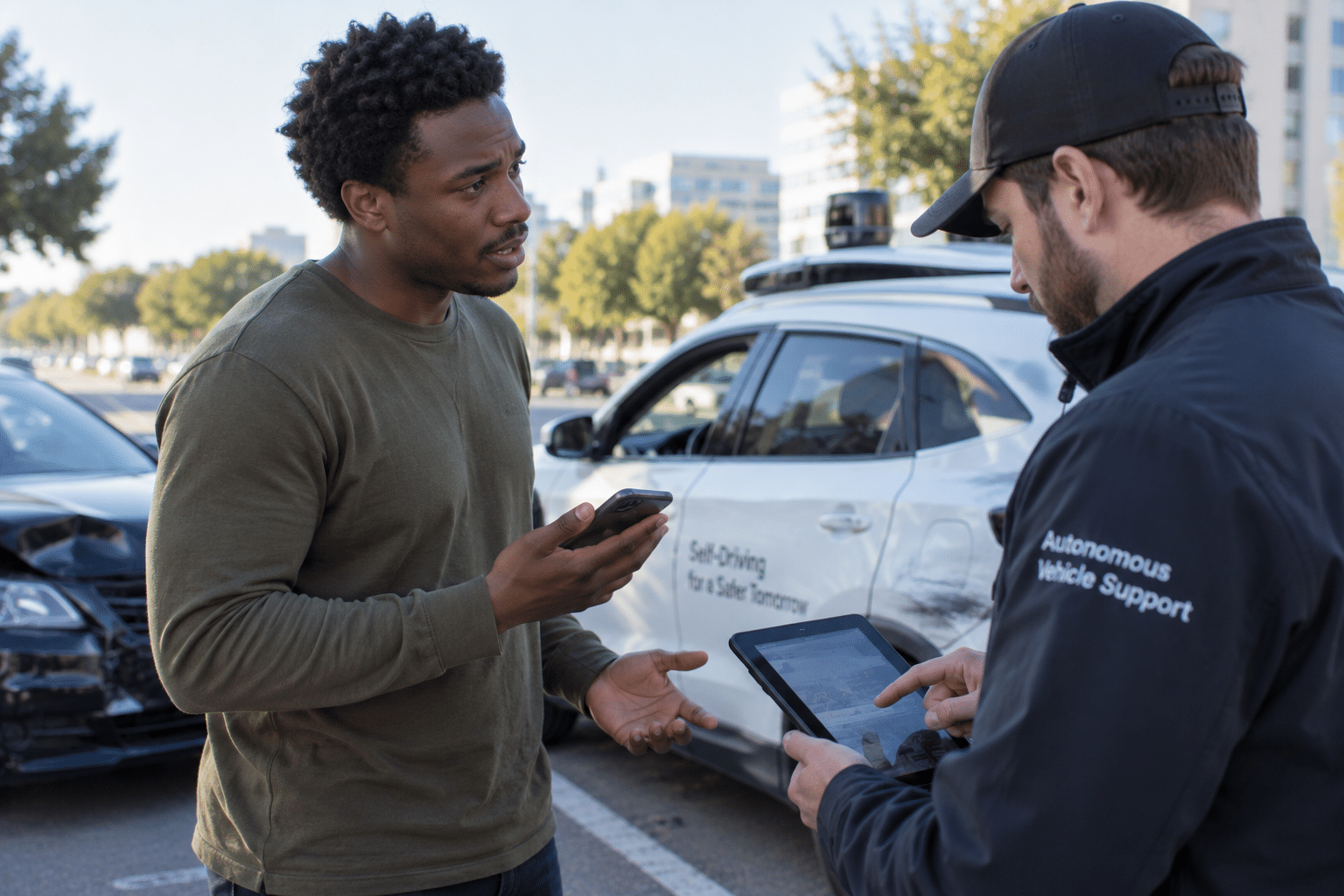
When you are injured in a collision involving a driverless car in Austin, you expect the autonomous vehicle (AV) company to step up, take accountability, and cover your medical bills, lost wages, and pain. Instead, many victims face a confusing corporate deflection strategy: the AV company claims the vehicle’s software did not fail, but rather a remote operator made an error.
Whether your crash happened near the UT Austin campus, along the I-35 corridor, or on South Congress, pointing fingers at a remote monitor is a classic corporate tactic to dodge liability. By shifting the blame away from systemic software glitches and onto an individual employee or third-party contractor, the tech company hopes to lower its settlement payouts. Understanding how Texas law governs these situations—and how to fight back when a company points fingers—is essential to protecting your recovery.
Why AV Companies Blame Remote Operators
Autonomous fleets operating in Central Texas rely on complex machine-learning algorithms, LiDAR, radar, and camera networks. When the software encounters a situation it cannot resolve—such as unexpected road construction or a confusing traffic signal—it often requests human assistance via a remote operator.
When a crash occurs, AV companies may point to these remote teleoperations technicians to escape massive product liability lawsuits. Their legal defense team might argue:
- The remote operator took manual control and made an incorrect steering or braking input.
- The remote monitor failed to respond quickly enough to a system alert or warning prompt.
- The remote technician improperly cleared a safety hold, allowing the vehicle to proceed when it should have stayed stopped.
By framing the wreck as an isolated case of human error rather than a dangerous, fleet-wide software flaw, the corporation tries to protect its valuation and avoid costly system recalls.
Does the Remote Operator Blame Game Shift Legal Liability in Texas?
In short: No, it does not clear the AV company. Under Texas law, trying to pass the buck to a remote employee or contractor rarely shields the fleet owner from financial responsibility.
Under Chapter 545 of the Texas Transportation Code, the owner of an automated driving system is considered the legal driver of the vehicle when the autonomous feature is engaged. Furthermore, Texas legal doctrines firmly establish that companies are legally and financially accountable for their workers’ actions:
- Respondeat Superior (Employer Liability): Under Texas employment law, an employer is vicariously liable for negligent actions committed by an employee who is acting within the scope of their job duties. If a remote operator employed by an AV company makes a mistake while monitoring a car on Austin streets, the company remains legally on the hook for your injuries.
- Negligent Hiring, Training, and Supervision: If the company claims the remote operator failed to act appropriately, severe questions must be asked about the company itself. Did they adequately train the operator? Were remote monitors forced to oversee too many vehicles simultaneously? Did latency, poor video streams, or buggy remote interface tools delay the operator’s ability to act safely?
- Product Liability and System Design: An autonomous system that routinely puts remote humans in unwinnable, split-second safety situations may be fundamentally defective by design. If a vehicle hands off control to a human without sufficient lead time to prevent a collision, the software developer shares direct responsibility.
Texas Legal Time Limit: In Texas, personal injury and wrongful death lawsuits arising from an autonomous vehicle crash must be filed within two years of the incident date under Tex. Civ. Prac. & Rem. Code § 16.003. Electronic data logging systems can be overwritten quickly, making early legal action critical.
Uncovering the Truth Through Digital Evidence
When an AV firm blames a remote operator, we do not simply take their word for it. Proving what really caused your wreck requires seizing and analyzing proprietary electronic data held exclusively by the tech company.
Key pieces of digital evidence that reveal true liability include:
- Teleoperation Logs and Disengagement Data: Exact timestamps showing when the automated system requested human intervention, when the operator responded, and what inputs were executed.
- Audio/Video Feeds: Internal cabin feeds, external multi-angle camera recordings, and audio logs from the remote operator’s workstation.
- Network Latency Metrics: Records showing communication delays between the vehicle’s onboard sensors and the remote monitoring station.
- Sensor and Telemetry Data: Raw LiDAR and radar logs establishing what the vehicle saw in the seconds leading up to impact.
Tech companies will not hand over this critical evidence voluntarily. A formal spoliation warning and immediate legal action are required to prevent data deletion or overwriting.
Stand Up to Tech Giants with an Experienced Austin Advocate
When a multi-billion-dollar autonomous vehicle corporation tries to minimize your payout by blaming an employee, you need a relentless, trial-ready advocate on your side. Joe Lopez has spent over two decades fighting for injured victims across Austin and Central Texas, recovering over $100 million for clients while taking on powerful corporate entities, insurers, and high-volume defendants.
Joe Lopez Law limits its caseload intentionally. Unlike high-volume personal injury practices where your file is passed around to junior staffers or paralegals, you work directly with Joe Lopez from day one. We prepare every case for trial, ensuring that tech companies, fleet owners, and insurance adjusters treat your claim with the seriousness it deserves. Our firm handles every aspect of your legal case and connects you with top regional medical specialists so you can focus entirely on your physical recovery. We work on a contingency fee basis—meaning zero upfront costs and no fee unless we win. Whether you prefer to communicate in English or Spanish (Se Habla Español / El Joe Me Ayudó), we are ready to stand by your side.
If you were injured in a driverless vehicle crash in Travis County or Central Texas, do not let corporate finger-pointing deny you full compensation. Contact an experienced Austin Autonomous Vehicle Accident Attorney at Joe Lopez Law today to schedule your free, confidential case evaluation.