

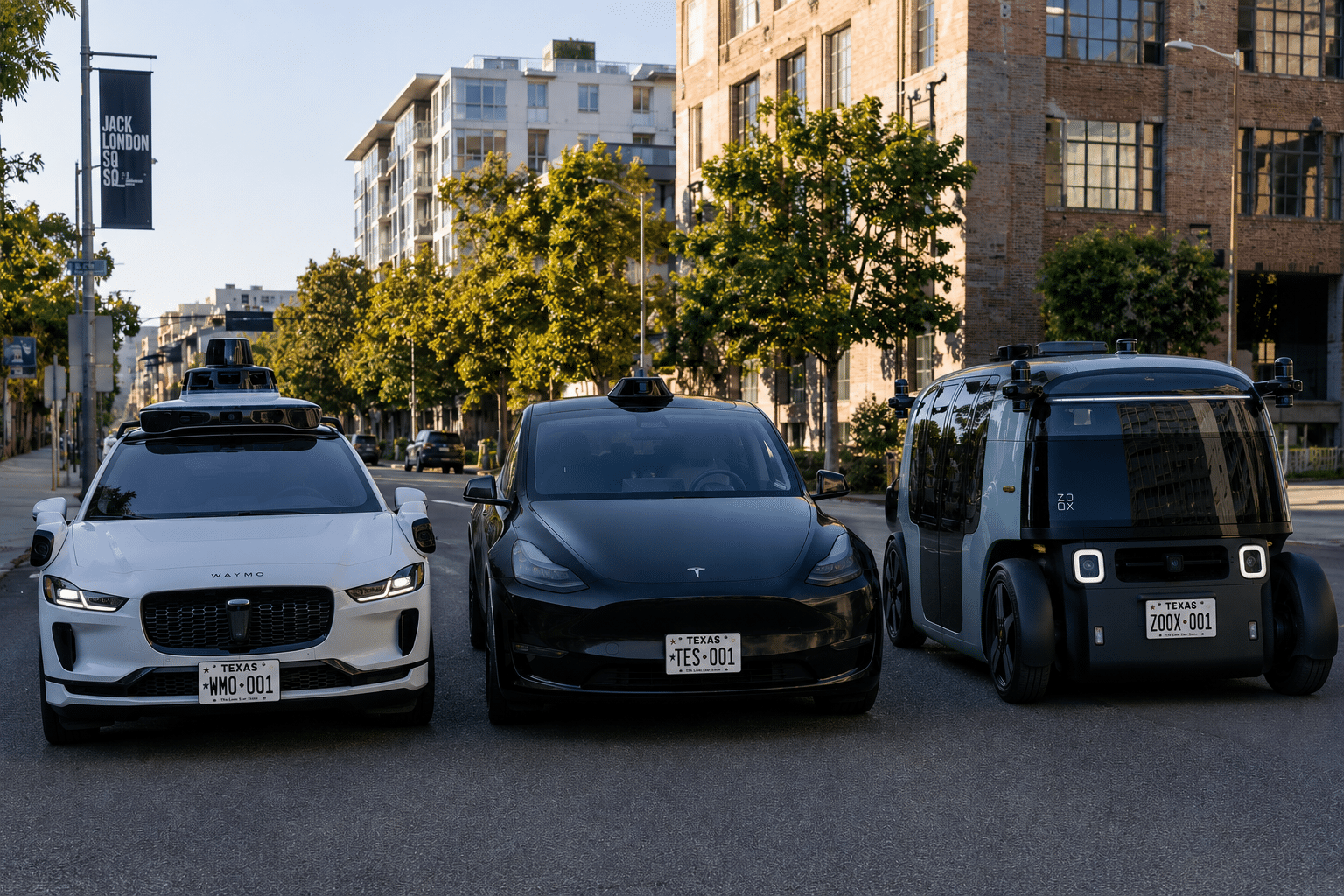
If you drive down South Congress, navigate the congested lanes of I-35, or commute through downtown Austin, you have likely shared the road with an autonomous vehicle (AV). Companies like Waymo, Tesla, and Zoox are rapidly testing and deploying self-driving fleets across Central Texas.
However, when a crash occurs, a critical question emerges for accident victims and curious residents alike: Does Texas law treat Waymo, Tesla Robotaxi, and Zoox differently when it comes to regulation, licensing, and legal liability?
The short answer is yes—and no. While Texas state statutes establish a unified statutory framework for automated motor vehicles, the underlying technology, vehicle design, and operational models create vast differences in how personal injury claims and corporate liability are handled in court.
The Foundation: How Texas Law Regulates Autonomous Vehicles
To understand how these specific companies compare, you first need to look at Texas Transportation Code Chapter 545, Subchapter J (Automated Motor Vehicles).
Enacted to position Texas as a national hub for AV testing and commercial deployment, Texas state law preempts local municipalities like the City of Austin from banning autonomous vehicles or enforcing local custom ordinances. Under state law:
- No Human Driver Required: An automated driving system (ADS) can operate without a human driver physically present inside the vehicle, provided the system is fully engaged.
- The Owner is the Legal Driver: For legal purposes under Texas law, the owner of the automated driving system is considered the “operator” of the vehicle when the ADS is engaged.
- Statewide Uniformity: AVs must comply with standard traffic laws, maintain mandatory commercial insurance, and be equipped with recording devices to capture operational telemetry data.
Key Texas Legal Takeaway: Under Texas Transportation Code § 545.454, when an automated driving system is fully engaged, the owner of that system is legally considered the operator of the vehicle—regardless of whether a human is sitting in the driver’s seat.
While this statutory baseline applies to all driverless technology operating on Texas roads, the legal strategy for holding Waymo, Tesla, or Zoox accountable after an accident differs dramatically based on how each company builds, trains, and operates its vehicles.
1. Waymo: Commercial Fleet & Fully Driverless Rideshare
Waymo (owned by Alphabet/Google) operates a fully autonomous ride-hailing service utilizing modified commercial vehicles, such as electric Jaguar I-PACE SUVs outfitted with roof-mounted LiDAR, radar, and high-definition cameras.
Legal Treatment Under Texas Law:
- True Level 4 Autonomy: Waymo operates as a commercial fleet with no human safety driver present. Under Texas law, liability for a crash caused by a Waymo vehicle typically bypasses individual human driver error and points directly to corporate liability.
- Product Liability vs. Commercial Carrier Negligence: If a Waymo vehicle runs a red light or cuts off a motorcyclist on Lamar Boulevard, the legal claim centers on software malfunction, sensor perception failure, or negligent fleet maintenance.
- High Insurance Requirements: As commercial entities operating driverless passenger services, Waymo fleets must maintain high-limit insurance policies and submit mandatory incident reports to federal regulatory bodies like the National Highway Traffic Safety Administration (NHTSA).
2. Tesla Robotaxi: Consumer Hardware & Vision-Based Autonomy
Tesla’s approach to autonomous technology differs radically from both Waymo and Zoox. Tesla relies exclusively on vision-based camera systems (Full Self-Driving / FSD) rather than expensive LiDAR sensors. Furthermore, Tesla’s autonomous footprint spans both consumer-owned passenger cars and proposed commercial Robotaxi services.
Legal Treatment Under Texas Law:
- The Driver Assist Ambiguity (Level 2 vs. Level 4): In existing consumer Teslas using FSD or Autopilot, the human behind the wheel is legally classified as the driver and must remain attentive. In court, Tesla frequently argues that the human driver retained ultimate control and responsibility for the vehicle.
- The Cybercab / Dedicated Robotaxi Shift: For dedicated Robotaxis operating without steering wheels or pedals, Texas law shifts the driver definition entirely to Tesla (or the fleet operator).
- Complex Liability Defenses: In crash litigation, Tesla frequently points to complex driver disengagement logs. Proving liability against Tesla requires deep technical discovery, including analyzing cabin camera footage, telemetry data, and software update logs to establish whether the system failed or transferred control back to a human at the last second.
3. Zoox: Custom-Built, Purpose-Designed Pods
Zoox (owned by Amazon) takes a unique approach by building bidirectional, custom-designed electric vehicles from the ground up. Zoox vehicles do not have traditional driver controls—no steering wheel, no gas pedal, and no brake pedal.
Legal Treatment Under Texas Law:
- Zero Driver-Contributory Negligence: Because a Zoox vehicle physically cannot be driven by a human passenger, defense lawyers cannot attempt to blame a vehicle occupant for failing to take the wheel. The human inside is strictly a passenger.
- Federal Motor Vehicle Safety Standards (FMVSS): Because Zoox eliminates traditional controls, it requires special federal exemptions and regulatory approvals to operate on public roads. Under Texas law, any failure to comply with federal manufacturing safety mandates creates strong grounds for strict product liability claims.
- Amazon Corporate Accountability: As a subsidiary of Amazon, Zoox claims involve massive corporate insurance policies, specialized fleet maintenance logs, and proprietary sensor data mapping.
Side-by-Side Comparison: How Texas Law Applies
| Feature / Legal Issue | Waymo | Tesla (FSD / Robotaxi) | Zoox |
|---|---|---|---|
| Primary Technology | LiDAR, Radar, Cameras | Vision Cameras Only | 360° LiDAR, Radar, Cameras |
| Traditional Controls? | Yes (Steering wheel intact) | Yes (Consumer) / No (Cybercab) | No (Purpose-built pod) |
| Legal Operator Under TX Law | Fleet Operator / System Owner | Human Driver (FSD) or System Owner (Robotaxi) | Fleet Operator / System Owner |
| Common Legal Defense | System anomaly / Sudden road hazard | Driver inattention / Late disengagement | Third-party driver negligence |
| Primary Claim Type | Corporate Negligence / Product Liability | Comparative Negligence vs. Product Liability | Pure Strict Product Liability |
The Challenges Victims Face in Autonomous Vehicle Crashes
When a standard car collision happens in Travis County, proving fault usually comes down to police reports, eyewitness testimony, and standard auto insurance policies. But when an autonomous vehicle is involved, corporate defense legal teams move immediately to protect their proprietary software and data.
Victims injured in AV accidents face several significant hurdles:
- Data Blackout: The critical evidence—telemetry, sensor logs, and disengagement reports—is stored on private servers owned by Waymo, Tesla, or Zoox. Without immediate legal intervention, this data can be overwritten or withheld.
- Corporate Finger-Pointing: Tech companies often blame third-party motorists, sudden pedestrian movements, or mapping errors to avoid liability.
- Complex Product Liability Law: Proving a software algorithm or sensor pod was defectively designed requires high-level forensic engineering experts and computer science specialists.
To understand the regulatory framework governing autonomous testing and registration in Texas, you can review the Texas Department of Motor Vehicles Autonomous Vehicle Guidelines for official details on commercial fleet compliance.
Fighting Corporate Tech Giants in Central Texas
Taking on Fortune 500 tech companies and multinational automakers requires more than basic personal injury knowledge. It demands a trial lawyer who refuses to be outgunned by massive defense teams and who treats every client with undivided, personal attention.
Since 2003, Joe Lopez has fought exclusively for injured victims and grieving families across Austin and Central Texas. Having recovered over $100 million for clients, Joe Lopez Law intentionally maintains a selective caseload so that every client works directly with their trial attorney—never a case manager or junior associate. From unearthing hidden corporate data to taking on major corporate defendants in court, our firm has the experience, resources, and tenacity required to hold autonomous vehicle operators fully accountable.
If you or a loved one was injured in a crash involving an autonomous vehicle, contact an experienced Austin Autonomous Vehicle Accident Attorney at Joe Lopez Law today for a free, confidential consultation. Se habla español—El Joe Me Ayudo!
This article is intended for general informational purposes only and does not constitute legal advice. No attorney-client relationship is formed by reading this content. For advice specific to your situation, please consult a licensed attorney in Texas.