




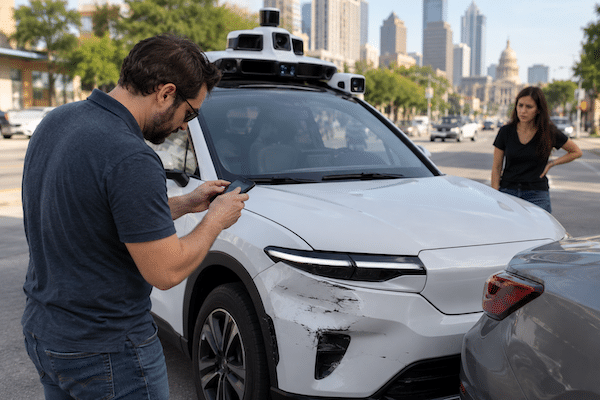
If you or a family member was involved in a collision with an autonomous vehicle in Austin or anywhere in Central Texas, the physical, emotional, and financial strain can feel overwhelming. Navigating emergency medical bills, missed work, and calls from corporate adjusters is hard enough after a traditional crash—adding complex software, automated driving systems, and massive tech companies into the mix only intensifies the pressure.
Many accident victims assume that when a vehicle operates without a human driver, liability becomes an impossible legal grey area. That is simply not true. Texas law does cover autonomous vehicle accidents, and victims have clear legal rights to seek full financial recovery for their injuries and losses.
How Texas Law Regulates Autonomous Vehicles
Texas has established itself as a primary testing and operational ground for autonomous vehicles (AVs), including passenger robotaxis and heavy commercial 18-wheelers. The state’s legal framework is governed directly under Subchapter J of Chapter 545 of the Texas Transportation Code.
Key statutory rules governing autonomous vehicles on Texas roads include:
- Legal Status of the System: Under Texas Transportation Code § 545.454, an automated driving system (ADS) can operate without a human driver present in the vehicle, provided the vehicle complies with state traffic laws and is equipped with a compliant recording device.
- Designated Operator: The owner of the automated driving system is considered the statutory “operator” of the vehicle for traffic law compliance, regardless of whether a human is sitting inside.
- Mandatory Financial Responsibility: Texas law mandates that AV owners carry minimum insurance coverage or prove financial responsibility before placing autonomous fleets on public roads.
- Crash Duties: Following a collision, the owner or automated system must comply with standard Texas accident reporting requirements, ensuring law enforcement and emergency services receive essential collision data. You can view state collision reporting guidelines directly through the Texas Department of Transportation Crash Reporting Portal.
Key Takeaway: An empty driver’s seat does not eliminate legal responsibility. Texas law treats automated driving systems as legal operators, ensuring injured victims can pursue financial recovery.
Establishing Liability: Who Is Responsible in a Self-Driving Crash?
Unlike standard automobile collisions where fault rests almost entirely on human driver error (such as distracted driving or speeding), autonomous vehicle crashes involve multi-layered liability. Determining who pays for your damages depends on how and why the failure occurred.
1. The Autonomous System Developer / Manufacturer
If a failure occurs because the artificial intelligence software misread road markings, failed to recognize a pedestrian, or executed an unsafe maneuver, the company that designed the software or manufactured the vehicle can be held strictly liable. Under Chapter 82 of the Texas Civil Practice and Remedies Code (the Texas Products Liability Act), victims can file claims based on design defects, manufacturing errors, or inadequate warnings.
2. Fleet Operators and Technology Rideshare Platforms
Commercial operators deploying self-driving fleets across Austin streets owe a duty of reasonable care. If a fleet operator failed to install critical software updates, deployed vehicles in weather conditions exceeding system capabilities, or ignored known sensor glitches, they may face direct negligence claims.
3. Human Safety Drivers or Vehicle Occupants
In partially autonomous systems (such as Level 2 or Level 3 driver-assist technology), human operators are legally required to monitor the road and intervene during hazards. If a human safety driver was distracted, under the influence, or failed to take control when prompted, traditional driver negligence rules apply.
Essential Evidence in Texas Self-Driving Cases
Proving liability after a collision with a self-driving vehicle requires immediate technical evidence preservation. Major tech developers and corporate operators move quickly to protect their proprietary algorithms and limit liability.
Critical evidence that must be secured includes:
- Event Data Recorders (EDRs) & Black Box Logs: Telematics data showing speed, braking inputs, sensor detection sequences, and system status seconds before impact.
- LiDAR, Radar, and Optical Camera Feeds: Internal and external sensor recordings capturing what the vehicle “saw” prior to the crash.
- Software Versioning & Maintenance Logs: Records detailing whether software patches, sensor calibrations, and system maintenance were properly executed.
- Internal Safety Audits: Corporate communications and known risk assessments regarding system glitches or safety limitations.
Under Texas Civil Practice and Remedies Code § 16.003, injured victims generally have two years from the date of the collision to file a personal injury lawsuit. However, waiting can result in vital onboard data being overwritten or deleted. Spoliation letters demanding the preservation of digital records should be issued immediately.
Why You Need an Experienced Austin Trial Attorney
Fighting multi-billion-dollar technology corporations and international motor carriers is not a battle for high-volume advertising firms or junior case managers. Corporate defendants deploy teams of specialized defense lawyers to delay claims, obscure technical data, and minimize payouts.
Navigating complex liability, securing electronic logs, and holding corporate defendants accountable demands a battle-tested advocate who treats your case with the individual focus it deserves. If you or a loved one suffered severe injuries in a collision involving an autonomous car or truck in Austin, reach out to an Austin car accident lawyer who has spent over two decades standing up to major corporations, uncovering hidden evidence, and fighting for full justice on behalf of injured Texans.