
Downtown Austin is a vibrant hub of activity, from the tech offices of Congress Avenue to the nightlife of Sixth Street and the scenic trails of Lady Bird Lake. In recent years, the city’s landscape has been transformed by the “last-mile” transportation revolution: electric scooters. While Bird, Lime, and Spin offer a convenient way to navigate Austin’s notorious traffic, they have also introduced a new layer of danger to our streets.
If you’ve spent any time downtown, you’ve likely witnessed a “near miss” involving a scooter. Unfortunately, many people aren’t so lucky. When a scooter collision occurs, the legal aftermath is significantly more complex than a standard car accident. Between restrictive user agreements, insurance gaps, and evolving city ordinances, determining who pays for medical bills and property damage is a legal minefield.
As an Austin e-scooter accident lawyer, Joe Lopez Law is dedicated to helping victims navigate these complexities. Here is what you need to know about liability, insurance, and your rights following a scooter crash in Central Texas.
Austin’s E-Scooter Explosion and the Surge in Accidents
Austin was one of the first major U.S. cities to embrace dockless mobility. What began as a novelty has become a permanent fixture of our urban infrastructure. However, the rapid rollout of these devices outpaced the city’s ability to create dedicated infrastructure, leading to a more dangerous environment on sidewalks and roads.
The convenience of these scooters comes at a cost. Unlike car drivers, scooter riders are often inexperienced, unprotected by helmets or vehicle frames, and sometimes operating the devices under the influence of alcohol. When these factors collide with Austin’s heavy vehicle traffic and crowded pedestrian walkways, the results are often catastrophic.
E-Scooter Accident Statistics in Austin
According to data collected by Austin Public Health and the Texas Department of Transportation, the influx of scooters led to a measurable spike in emergency room visits.
Key findings from local data, as detailed in the Austin Public Health Dockless Electric Scooter-Related Injuries Study, include:
- Head Injuries: Nearly half of all injured riders in Austin sustained head injuries, many of which were traumatic brain injuries (TBI).
- Inexperience: Over 30% of injured riders were on their very first scooter ride when the accident occurred.
- Location: The vast majority of incidents occur in the downtown sector (78701 zip code) and near the University of Texas at Austin campus.
Common E-Scooter Crash Scenarios
Because scooters occupy a gray area between pedestrians and motor vehicles, they are involved in a wide variety of accident types.
1. Scooter vs. Car
These are often the most severe accidents. They frequently occur when a driver fails to spot a scooter in their blind spot or when a scooter rider “darts” into a crosswalk. “Dooring” is also a common issue in Austin, where a parked driver opens their door into the path of an oncoming scooter.
2. Scooter vs. Pedestrian
On crowded sidewalks like those on South Congress or the Drag, scooters frequently collide with pedestrians. Because scooters can travel up to 15 mph, the impact can cause elderly pedestrians or children to suffer broken hips, wrists, or internal injuries.
3. Scooter Rider Injuries (Solo Falls)
Not every accident involves another person. Many riders are injured due to mechanical failure (brake failure, collapsing handlebars) or poorly maintained city streets. Potholes, gravel, or uneven pavement that a car would easily roll over can cause a scooter to flip, launching the rider onto the asphalt.
Who is Liable? Determining Fault in Austin
Texas is a “modified comparative negligence” state. This means that more than one party can be held responsible for an accident, and your recovery can be reduced by your percentage of fault. In an e-scooter case, liability can fall on several parties:
Scooter Rider Negligence
If a rider is weaving through traffic, ignoring red lights, or riding on a sidewalk where it is prohibited by Austin city ordinance, they may be held liable for any damages they cause to pedestrians or vehicles.
Vehicle Driver Fault
Drivers in Austin have a duty of care to share the road safely. If a driver is distracted by their phone, speeding, or fails to yield the right of way to a scooter in a bike lane, the driver (and their insurance) will likely be held responsible.
Pedestrian Actions
While rare, pedestrians can be at fault if they abruptly step into a designated bike lane or “jaywalk” in a manner that makes a collision unavoidable for a scooter rider.
City of Austin (Road Defects)
If a crash was caused by a massive pothole, obscured signage, or a dangerously designed intersection that the city knew about but failed to fix, there may be a claim against the municipality. However, suing a government entity in Texas involves strict notice requirements and “sovereign immunity” hurdles.
Scooter Company Responsibility
Could Bird, Lime, or Spin be responsible? If the accident was caused by a mechanical defect—such as a software glitch that caused the scooter to accelerate or brakes that failed—the company may be liable under product liability laws.
Bird, Lime, and Spin: What the User Agreements Really Say
Most users “accept” the terms and conditions in the app without reading them. These agreements are designed by some of the best corporate lawyers in the world to shield the companies from liability.
When you click “I Agree,” you are often agreeing to:
- Binding Arbitration: Giving up your right to sue the company in a court of law, forcing you into private arbitration instead.
- Indemnification: In some cases, the language suggests that the user must pay the company’s legal fees if the company is sued because of the user’s actions.
- Total Waiver of Liability: Claiming that the user assumes all risks, even if the scooter itself is faulty.
While these agreements are intimidating, they are not always enforceable under Texas law, especially if the company was grossly negligent. An experienced Bird Lime accident attorney can help challenge these “fine print” defenses.
The Insurance Coverage Gap: Who Pays the Bills?
The biggest hurdle in e-scooter litigation is insurance. Unlike cars, scooters do not carry insurance cards in the glove box. The National Highway Traffic Safety Administration (NHTSA) highlights these emerging issues as a significant challenge for urban safety and recovery.
Scooter Company Liability Policies
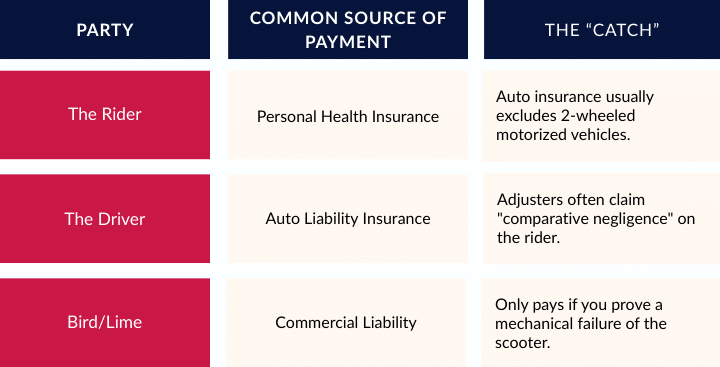
While companies like Lime and Bird carry massive commercial insurance policies, these are primarily designed to protect the company, not the rider. They rarely pay out unless you can prove a specific mechanical failure of the device.
The Rider’s Personal Insurance
- Auto Insurance: Most Texas auto insurance policies specifically exclude “motorized vehicles with fewer than four wheels.” This means your car insurance likely won’t cover you if you cause an accident on a scooter.
- Homeowners/Renters Insurance: Some policies offer personal liability coverage that might cover a collision with a pedestrian, but many have “motorized vehicle” exclusions that apply here as well.
The Driver’s Auto Insurance
If a car hits a scooter, the driver’s bodily injury liability coverage should apply. However, insurance adjusters often try to blame the scooter rider to reduce the payout, citing “unpredictable movement.”
Uninsured Options
If you are a rider hit by a “hit and run” driver, you may be able to use your own Uninsured Motorist (UM) coverage from your auto policy, even though you weren’t in your car at the time. This is a complex area of insurance law that requires a legal expert to navigate.
The Liability Triangle: Who Pays?
Texas E-Scooter Laws and Austin City Ordinances
To prove negligence, we often look at whether a party violated a law. In Austin, the rules for scooters are defined under the City of Austin Bicycle and Micromobility Laws and include:
- No Sidewalk Riding in Specific Zones: It is illegal to ride a scooter on sidewalks in the “Downtown Core” (between I-35 and Lamar, and Lady Bird Lake to 12th Street).
- Speed Limits: Most apps are programmed to cap speeds at 15 mph, but the city can enforce lower limits in high-pedestrian areas.
- Parking Rules: Abandoning a scooter in a way that blocks a sidewalk (ADA violation) can lead to liability if someone trips and is injured.
- One Rider Per Scooter: Tandem riding is a violation of city code and is a common cause of accidents.
Proving Fault: The Evidence You Need
Because these cases often turn into a “he-said, she-said” situation, evidence is critical.
- App Data: The scooter companies track GPS location, speed, and braking patterns. This data can prove if a rider was speeding or if the brakes failed.
- Video Surveillance: Downtown Austin is covered in cameras. From “HALO” police cameras to private business security footage (like those from bars on 6th Street), capturing the moment of impact is vital.
- Witnesses: Pedestrians and other riders often see the lead-up to the crash.
- The Scooter Itself: If you suspect a mechanical failure, the scooter must be “preserved” as evidence before the company picks it up and repairs it, essentially erasing the proof.
Common Injuries in Austin Scooter Crashes
Without the protection of an airbag or seatbelt, scooter victims often sustain. Federal research from the National Transportation Safety Board (NTSB) indicates that head injuries and upper limb fractures are the most prevalent outcomes in these crashes.
- Severe Road Rash: Asphalt at 15 mph acts like sandpaper, often leading to permanent scarring or the need for skin grafts.
- Complex Fractures: “FOOSH” injuries (Falling On Out-Stretched Hand) lead to shattered wrists, elbows, and collarbones.
- Head Trauma: Concussions and TBIs are common, as very few rental users wear helmets.
- Facial Injuries: Broken noses, lost teeth, and jaw fractures occur when riders are thrown forward over the handlebars.
What if the Rider Flees?
“Hit and run” scooter accidents are a growing problem in Austin. A rider may strike a pedestrian and simply zip away into an alley or crowd. In these cases, we look for:
- Digital Footprints: We can work to subpoena the scooter companies to see which user was active in that specific GPS coordinate at the time of the crash.
- Credit Card Trails: Since every ride is tied to an account, there is always a paper trail.
How to Protect Yourself: Driver, Rider, or Pedestrian
- As a Rider: Always wear a helmet, stay off the sidewalks downtown, and never ride after drinking.
- As a Driver: Give scooters a wide berth. Expect them to make sudden moves. Check your blind spots twice before turning across a bike lane.
- As a Pedestrian: Stay alert. Avoid looking at your phone while walking in high-scooter traffic areas.
Why You Need an Austin E-Scooter Accident Lawyer
E-scooter cases are complicated because the law is still catching up to the technology. Insurance companies will use this ambiguity to deny your claim. They will argue that you “assumed the risk” by stepping onto the scooter or that their policy doesn’t cover “micro-mobility” devices.
At Joe Lopez Law, we understand the nuances of Texas transportation law and Austin’s specific city ordinances. We know how to deal with tech giants like Bird and Lime and how to find the insurance coverage you need to pay for your recovery.
Contact Joe Lopez Law Today
If you have been injured in a scooter crash—whether you were the rider, a pedestrian, or a driver—you deserve a Texas scooter injury claim expert on your side. We provide aggressive representation and compassionate guidance to help you get your life back on track.
Call us today at (512) 580-9962 or contact us online for a free, no-obligation consultation. We handle all personal injury cases on a contingency fee basis, meaning you don’t pay unless we win your case.
