
If you’ve been involved in a motor vehicle accident in Austin, the moments following the collision are often a blur of adrenaline, confusion, and physical pain. Once the dust settles and you begin the process of filing an insurance claim or seeking legal counsel, one document will sit at the center of your case: the Texas Peace Officer’s Crash Report (Form CR-3).
In the legal world, the police report is often treated as the “official” story of what happened. Insurance adjusters rely on it heavily to determine liability, and while it isn’t always admissible in court as absolute fact, it sets the tone for every negotiation that follows. However, police officers are human. They make mistakes—and in a high-stakes personal injury case, a single checked box or a misinterpreted skid mark can cost you thousands of dollars.
Understanding how to read your Austin police crash report is the first step in protecting your rights. Here is a comprehensive guide to the CR-3 form and what to do if the officer didn’t get the story right.
How to Obtain Your Austin/Texas Crash Report
Before you can analyze the report, you need to get your hands on the official copy. In Texas, crash reports are not public records in the sense that anyone can view them; you must be an “involved party” (driver, passenger, vehicle owner, or legal representative) to access the full, unredacted report.
There are two primary ways to obtain your report in Austin:
- The TxDOT CRIS System: The Texas Department of Transportation maintains the Crash Report Online Purchase System. You will typically need the full name of a person involved, the date of the crash, and the VIN or Driver’s License number. There is usually a small fee (approx. $6–$8).
- The Austin Police Department (APD): You can request reports through the APD’s database or via an open records request, though most people find the state’s CRIS system faster.
Pro Tip: It can take up to 10–14 days for an officer to complete and file the report. If you try to find it the day after the accident and it isn’t there, don’t panic—check back a week later.
Understanding the Format: The Texas CR-3 Form
Texas uses a standardized form called the CR-3. Even if your accident was handled by an Austin PD officer, a Travis County Sheriff’s deputy, or a State Trooper, the format will be the same.
The CR-3 is a dense, multi-page document filled with codes, abbreviations, and diagrams. To the untrained eye, it looks like a spreadsheet. However, every section contains “data points” that insurance companies plug into their software to decide how much (if anything) they want to pay you.
Key Sections Explained
1. Header Information and Report Number
At the top, you’ll find the Case ID or Service Number. This is the most important number for your records. If you call the police department or talk to an insurance adjuster, this is the reference number they will use to pull up your file. It also lists the exact date, time, and location (GPS coordinates or street address) of the crash.
2. The Crash Narrative
Usually located on the second or third page, this is where the officer writes a brief summary of what they believe happened. This is often the most contentious part of the report. The officer will interview drivers and witnesses (if they have time) and synthesize those stories into a narrative.
- Watch out for: “Unit #1 stated…” vs “Unit #2 stated…” The officer often labels the driver they believe is “at fault” as Unit #1.
3. The Diagram/Scene Sketch
The CR-3 includes a box for a visual representation of the accident. It shows the direction of travel, the point of impact, and where the vehicles came to rest. While these aren’t drawn to scale, they are critical for showing “point of impact” evidence—such as whether a car was hit in the rear or the side.
4. Vehicle and Person Information
This section lists the year, make, and model of the vehicles, insurance information, and the names/addresses of all drivers and passengers.
- Crucial Detail: Check the “Airbag” and “Seatbelt” columns. If the officer incorrectly notes that you weren’t wearing a seatbelt, the insurance company will use this to argue that you contributed to your own injuries.
5. Contributing Factors (The “Checkboxes”)
This is arguably the most important section for your personal injury claim. There is a list of numeric codes representing “Contributing Factors.” Common codes include:
- 22: Failed to yield right of way
- 45: Had been drinking
- 60: Speeding (Over limit)
- 61: Speeding (Unsafe for conditions)
- 67: Followed too closely
If the officer assigns a code to you, the insurance company will likely deny your claim or reduce your settlement based on “comparative negligence.”
6. Officer’s Assessment of Fault & Citations
The report will indicate if any citations (tickets) were issued. If the other driver was ticketed for “Failure to Control Speed” or “Disregarding a Red Light,” your case for liability is significantly stronger. However, just because a ticket wasn’t issued doesn’t mean the other driver isn’t at fault.
7. Injury Classifications
Texas uses a coding system for injuries:
- A: Suspected Serious Injury (Incapacitating)
- B: Non-incapacitating Injury (Visible injury like a cut or bruise)
- C: Possible Injury (Complaint of pain, but no visible wound)
- N: No Injury
- 99: Unknown
Why this matters: If you told the officer “I’m okay, just a little shaken up” because you were in shock, they might mark you as “N” (No Injury). If you later discover you have a herniated disc or a concussion, the insurance company will point to that “N” and claim you are faking your injuries.
Common Errors in Police Reports
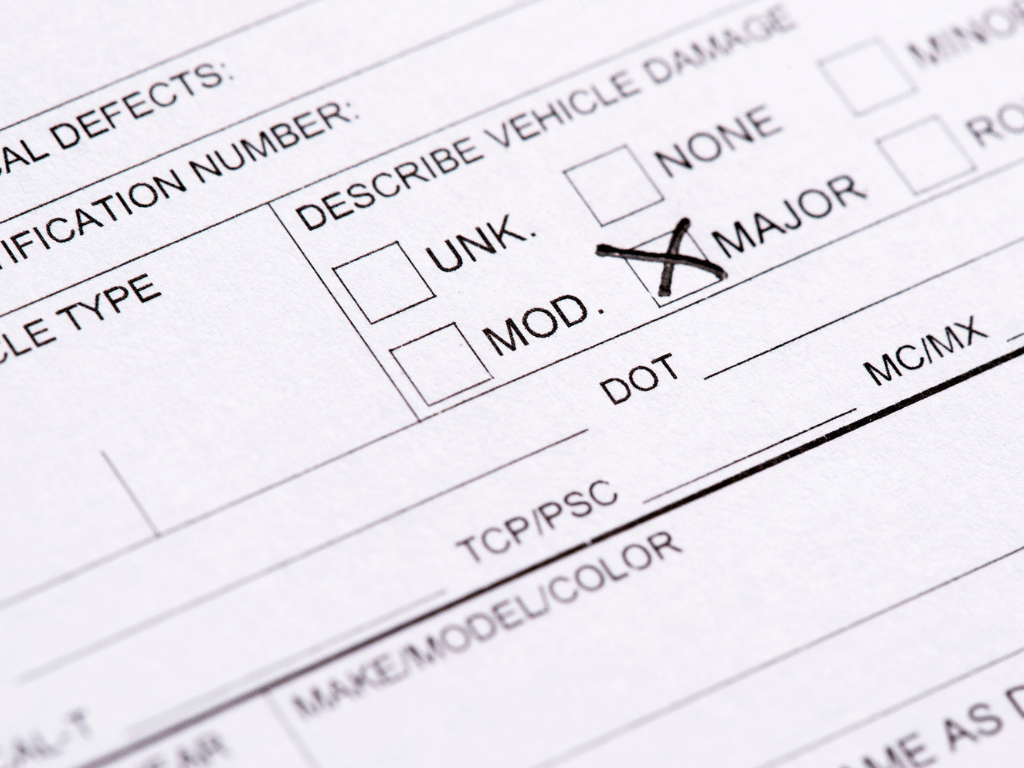
Despite their training, officers are often working in less-than-ideal conditions. In a busy city like Austin, an officer might be juggling three different calls while standing in the rain on I-35. This leads to frequent errors:
- Wrong At-Fault Party: The officer might mix up “Unit 1” and “Unit 2,” effectively blaming the victim for the crash.
- Inaccurate Narratives: The officer may mishear a statement or fail to speak to a witness who remained on the scene, leading to a one-sided story.
- Missing Witnesses: Often, independent witnesses leave before the police arrive. If their contact info isn’t in the report, their testimony might be lost forever.
- Incorrect Diagrams: Arrows pointing the wrong way or vehicles placed in the wrong lanes can fundamentally change the physics of the crash.
- Understated Injuries: As mentioned, the “N” or “C” codes often fail to reflect the reality of internal or soft-tissue injuries that manifest hours later.
Why Do Officers Get It Wrong?
It’s important to remember that most police officers are not accident reconstruction experts. Unless there is a fatality or a life-threatening injury, the “Total Response Team” (accident specialists) is rarely called out.
The patrol officer who arrives is usually:
- Rushed: They need to clear the roadway to prevent further traffic congestion.
- Relying on Assumptions: If they see a rear-end collision, they may automatically assume the rear driver was at fault without investigating if the front driver’s brake lights were out or if they cut the other driver off.
- Dealing with Incomplete Information: If one driver is being loaded into an ambulance, the officer may only get the story from the driver who stayed behind, leading to a biased report.
How Report Errors Hurt Your Austin Claim
In Texas, we follow a Modified Comparative Negligence rule (the 51% rule). This means if you are found to be 51% or more at fault, you cannot recover any compensation. If you are 20% at fault, your settlement is reduced by 20%.
If a police report incorrectly suggests you were speeding or distracted, the insurance adjuster will use that “official” document to devalue your claim. They will offer a “nuisance settlement” or deny the claim entirely, citing the officer’s findings.
Can You Correct a Police Report in Texas?
The short answer is: It’s difficult, but not impossible.
Police departments are generally reluctant to change a report once it has been filed, especially regarding “opinions” (like who was at fault). However, they are more willing to correct objective facts.
- Fact Errors: If the officer wrote down the wrong insurance policy, the wrong street name, or the wrong make of your car, you can usually get a “Supplemental Report” added by providing the correct documentation.
- Opinion Errors: If you disagree with the officer’s assessment of fault, you cannot simply ask them to “fix it.” You (or your lawyer) must provide new, “dispositive” evidence that proves the officer was mistaken.
What to Do If Your Report Is Wrong
If you’ve received your CR-3 and realize it contains damaging errors, you need to act quickly to build a “counter-narrative.”
1. Gather Contradicting Evidence
The police report is just one piece of evidence. If it’s wrong, you need more “weight” on your side of the scale. Collect anything that proves the officer’s version is physically impossible or factually incorrect.
2. Witness Statements
Did a bystander give you their number? Did a nearby shop owner see the crash? Official statements from neutral third parties carry significant weight and can override a police officer’s rushed assessment.
3. Photos and Video
In Austin, many intersections have traffic cameras, and many businesses have exterior security footage. Additionally, dashcam footage is the “Gold Standard” of evidence. If you have video of the other driver running a red light, it doesn’t matter what the officer wrote—the video wins.
4. Expert Accident Reconstruction
In high-stakes cases, your attorney may hire a professional accident reconstructionist. These experts use physics, crush patterns, and “black box” data (Event Data Recorders) from the vehicles to scientifically prove how the crash occurred.
How Attorneys Use Crash Reports in Negotiations and Litigation
A skilled Austin car accident attorney doesn’t view the police report as the “final word.” Instead, we use it as a starting point.
- During Negotiations: We use the report to highlight the other driver’s negligence (e.g., “The officer noted the defendant was distracted by a cell phone”).
- Identifying Hidden Defendants: The report might list the owner of the vehicle, which could lead to a “negligent entrustment” claim against a company or a parent.
- Challenging the Officer: In a deposition, an attorney can cross-examine the officer to show that their investigation was incomplete or that they didn’t have all the facts when they wrote the report.
For a Free Report Review Consultation Contact Joe Lopez
An Austin police crash report is a powerful document, but it isn’t infallible. If you see errors on your report, or if the officer blamed you for an accident that wasn’t your fault, you need to take action immediately.
At the Law Office of Joe Lopez, we know how to dissect a CR-3 form and find the inconsistencies that insurance companies try to hide. We work with experts to rebuild the scene and ensure that the truth—not just a rushed police narrative—determines the outcome of your case.
Was your Austin police crash report inaccurate?
Don’t wait for the insurance company to use it against you. Contact us today for a free report review and consultation. We will go over your report line-by-line and help you understand your legal options.
Contact Joe Lopez Law at (512) 580-9962 or visit us online to schedule your free case evaluation.
