
Austin’s weather can turn from sunny to catastrophic in minutes. When flash floods roll through, Central Texas sees an immediate surge in car accidents. According to a 2025 study analyzing Texas Department of Transportation (TxDOT) crash data, rainfall significantly increases crash risk on Texas roadways, with relative risk rising up to 1.5 times during moderate to heavy precipitation events compared to dry conditions—particularly in urban areas like Austin where flash flooding exacerbates hazards. This underscores how even routine rain can turn Austin’s roads into high-risk zones, amplifying the need to prove driver negligence in your claim.
But here’s the part insurance companies love to twist: just because it was raining, sleeting, or foggy doesn’t mean the at-fault driver walks away without responsibility. Texas still follows comparative fault rules. Even in terrible weather, every driver has a duty to slow down, increase following distance, turn on headlights, and drive according to conditions. Fail to do that and you can still be found at fault, even if the pavement was wet.
At Joe Lopez Law, we’ve handled hundreds of weather-related crashes across Travis, Williamson, and Hays counties. Below, we’ll show you exactly which weather patterns cause the most wrecks in Austin, why “it was raining” is almost never a complete defense, and how to protect your injury claim when Mother Nature is part of the story.
Austin’s Riskiest Weather Patterns for Drivers
Austin doesn’t get Midwest blizzards or Florida hurricanes, but our unique geography and sudden storms create their own deadly hazards.
- Flash Floods and Low-Water Crossings
Central Texas clay soil doesn’t absorb water quickly. When two inches of rain fall in an hour (a frequent occurrence in the spring and fall), creeks like Onion, Walnut, and Shoal explode out of their banks. Barton Creek can rise 20 feet in under 30 minutes. The notorious low-water crossings on Loop 360, City Park Road, and Spicewood Springs become death traps. - Hill Country Fog
Lady Bird Lake and the Colorado River cool the air overnight, especially in fall and winter. When warm, moist air moves in, dense radiation fog blankets South Congress, Riverside Drive, and Mopac. Visibility can drop below 50 feet with almost no warning. Morning commuters on 35 through downtown regularly encounter sudden “fog walls” that cause massive pile-ups. - Black Ice on Elevated Roads
We rarely see snow, but winter nights below freezing turn residual moisture on bridges and overpasses into invisible black ice. Northbound 183 near Braker Lane, the upper decks of I-35, and the Mopac express lanes are repeat offenders. Drivers traveling at highway speed suddenly lose control with no visible warning. - Hail and High Winds
Spring supercells around Austin can drop golf-ball or even softball-sized hail. Cracked windshields and distracted drivers swerving to get under overpasses cause secondary crashes. Winds gusting over 60 mph have flipped high-profile vehicles on 130 and 71.
Does Bad Weather Excuse Negligence in Texas?
Short answer: almost never completely.
Texas courts recognize the “sudden emergency” doctrine, but it’s extremely narrow. To use it successfully, a driver must prove (1) the emergency arose suddenly and unexpectedly, (2) it wasn’t caused by their own negligence, and (3) their reaction was what a reasonable person would do. Hydroplaning because you were speeding in the rain? That’s not a sudden emergency; that’s foreseeable.
Texas is a modified comparative fault state (51% rule). Even if weather contributed, the jury assigns percentages. We’ve seen cases where:
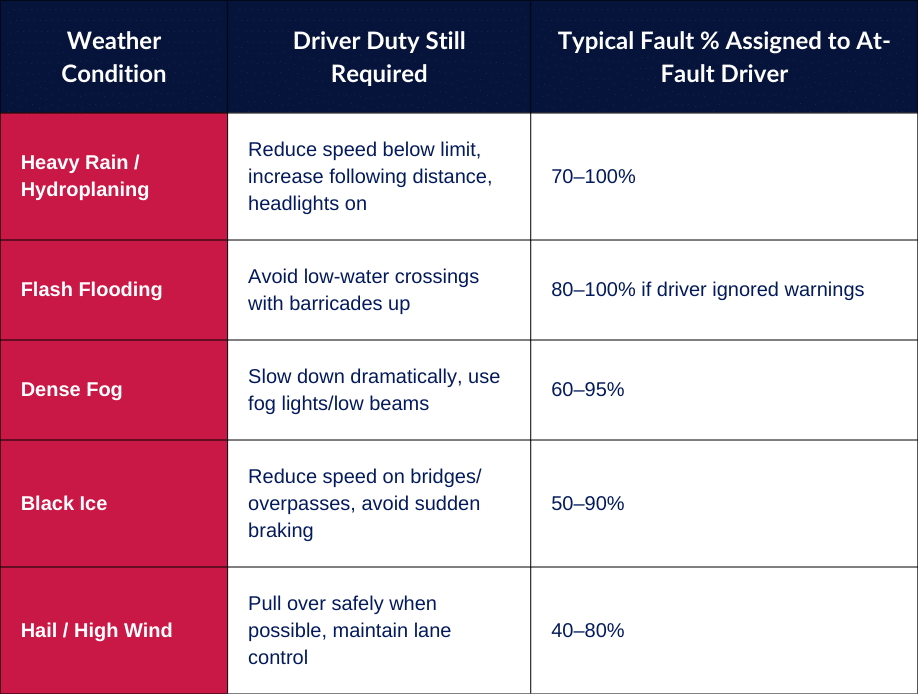
Insurance adjusters will immediately blame the weather to lowball you. That’s why these cases require aggressive evidence gathering from day one.
Evidence That Wins Weather-Related Car Accident Cases in Austin
The difference between a $40,000 offer and a seven-figure recovery is almost always documentation:
- Dashcam / cellphone video – Shows visibility, headlights of other vehicles, and speed.
- National Weather Service reports – Official hourly observations prove exact rainfall rates, wind gusts, and advisories in effect.
- TxDOT barricade and flood gauge photos – If a low-water crossing had barricades up and the driver went around them, game over.
- Tire tread depth photos and measurements – Texas law requires 2/32″ minimum. Less than that in rain is negligence per se.
- ECU “black box” download – Many modern vehicles record speed, braking, and throttle position 5–10 seconds before impact.
- Witness statements from drivers who successfully navigated the same conditions – Powerful proof that reasonable care was possible.
We preserve all of this evidence immediately, often the same day, because scenes change fast when the sun comes out.
Protect Your Claim After a Storm-Related Wreck in Austin
If you’ve been injured in a weather-related crash:
- Photograph everything: standing water depth, missing barricades, tire marks, damage pattern.
- Get the police report – Austin PD and Travis County deputies now note weather conditions and citations.
- Seek medical care the same day – delayed treatment kills claims.
- Do NOT give a recorded statement to the other insurance company without counsel.
Call Joe Lopez Law at (512) 580-9962 for a free case review. We advance all costs and only get paid if you win.
Download Our Free “Rain Wreck Evidence Checklist”
Frequently Asked Questions About Weather Car Accidents in Austin
Q: Can you still get sued if you caused a crash because of hydroplaning?
A: Yes, if your tires were worn, you were speeding, or you were distracted. Hydroplaning is foreseeable in Texas rain; bald tires or excessive speed remove most defenses.
Q: What if the city didn’t put up flood barricades in time?
A: You may have a claim against the governmental entity (sovereign immunity caps apply). At Joe Lopez Law, we can help you evaluate whether the facts of your crash meet the legal requirements to hold a government entity accountable.
Q: Does my own uninsured motorist coverage pay if the at-fault driver blames the weather?
A: Yes. UM/UIM is crucial in Austin because many at-fault drivers carry only minimum $30k limits that disappear fast in serious injury cases.
Q: How long do I have to file a weather-related car accident claim in Texas?
A: Typically two years from the date of the crash (per the statute of limitations). Miss it and you risk not having a case.
Conclusion: Weather Complicates Liability – It Doesn’t Erase It
Austin’s flash floods, fog, and ice make driving dangerous, but Texas law is clear: every motorist must adjust to conditions. The driver who speeds through a flooded low-water crossing or tailgates in zero-visibility fog is still responsible when tragedy strikes.
If you or a loved one has been injured in a weather-related wreck, don’t let the insurance company hide behind the rainclouds. The experienced Austin car accident attorneys at Joe Lopez Law know exactly how to prove fault, even when the skies opened up.
Contact us today for a free, no-pressure consultation. We’re here 24/7 because storms don’t keep office hours.
Joe Lopez Law – Fighting for Austin crash victims, rain or shine.
